
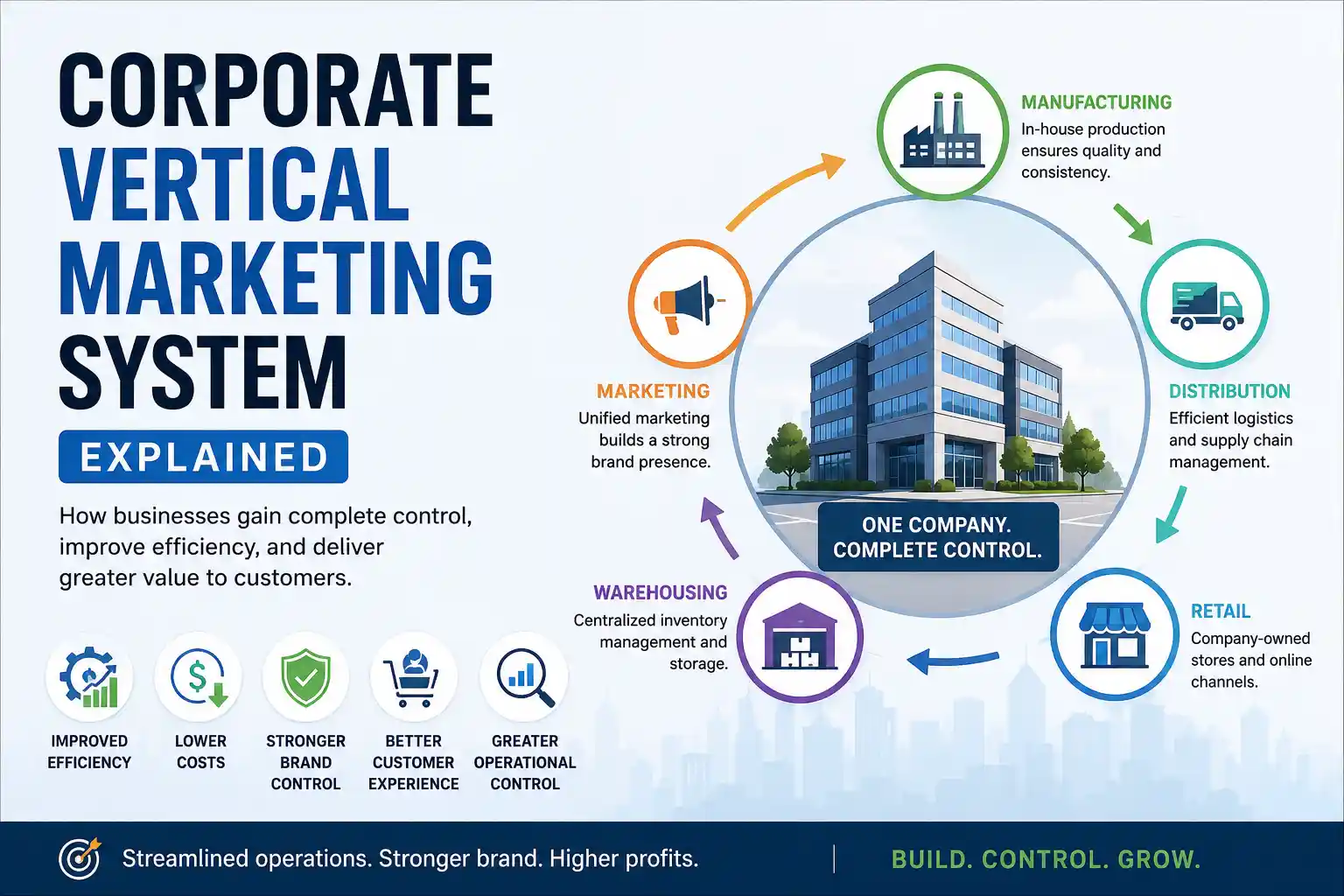
As businesses evolve and supply chain complexities increase, an innovative approach is needed to streamline operations and drive growth. That’s where the Corporate Vertical Marketing System (CVMS) comes in. This revolutionary concept can help businesses achieve improved efficiency and control in their operations, making it an essential tool for success.
In this section, we’ll explore the basics of CVMS, its key components, and the benefits it can bring to your business. With a better understanding of this marketing system, you can make informed decisions to drive your business’s success.
Read on to learn more about the Corporate vertical marketing system and how it can help your business achieve its goals.
Overview
A Corporate Vertical Marketing System (VMS) is a structure where successive stages of production and distribution are owned and controlled by a single enterprise. This model removes independent middlemen, allowing one organization to manage manufacturing, distribution, logistics, and retail operations more effectively.
Because the company oversees the complete supply chain, it gains greater control over pricing, inventory management, product quality, customer experience, and brand image.
Key Characteristics of Corporate VMS
Single Ownership
One enterprise owns or controls major parts of the production and distribution system, including factories, warehouses, logistics networks, and retail stores.
Total Operational Control
Businesses manage production schedules, pricing strategies, marketing channels, inventory flow, and customer service directly without depending heavily on external intermediaries.
Higher Efficiency
Since businesses coordinate operations internally, they can reduce delays, communication issues, and distribution conflicts while lowering operational costs.
Understanding how a corporate vertical marketing system works can also help graduates preparing for Career Entry-Level Corporate Law Jobs in large organizations with centralized management structures.
Understanding the Corporate Vertical Marketing System
The Corporate Vertical Marketing System (CVMS) is a business model designed to streamline supply chains, enhance efficiency, and establish operational control. It comprises a series of interconnected businesses that collaborate to produce and distribute goods and services to the end customer.
At the core of the CVMS is the vertical integration of the supply chain, eliminating unnecessary intermediaries and simplifying operations. This leads to faster response times and greater control over the production process, resulting in improved product quality and higher customer satisfaction.
Streamlining Supply Chains
The CVMS streamlines supply chains by reducing inefficiencies and redundancies. It creates a well-organized system to ensure that the right products are produced at the right time and delivered to the right place.
By controlling the supply chain, the companies involved in the CVMS can save time and costs associated with transactions, logistics, and communication, while maintaining quality and consistency.
Enhancing Efficiency and Control
The CVMS improves efficiency by eliminating unnecessary steps in production and distribution and maximizing economies of scale. This leads to cost savings and greater competitiveness.
Moreover, by controlling the entire supply chain, the CVMS companies can achieve greater operational control, allowing for better forecasting, planning, and risk management. This ensures that the production is efficient, effective and profitable, without compromising quality.
Overall, a Corporate Vertical Marketing System can provide significant benefits to companies operating in competitive industries that require efficient and streamlined operations.
Implementing a Corporate Vertical Marketing System
Implementing a Corporate Vertical Marketing Systems is a significant undertaking that requires careful planning and execution. The following steps are essential to ensure successful implementation:
1. Forge Strategic Partnerships
Strategic partnerships are key in successfully implementing a Corporate Vertical Marketing Systems. It involves collaborating with suppliers, distributors, and other key players in the supply chain to achieve common goals. By working together, companies can streamline their supply chains and improve operational efficiency.
2. Foster Collaboration
Collaboration across various departments and teams is crucial in implementing a Corporate Vertical Marketing Systems. By fostering collaboration between marketing, sales, and operations teams, companies can achieve a more synchronized and efficient supply chain that is better equipped to handle challenges.
3. Achieve Operational Control
Operational control is essential to ensure the smooth functioning of the Corporate Vertical Marketing Systems. This involves having a centralized system that provides visibility into the supply chain, enables real-time monitoring and tracking, and identifies and addresses issues proactively. By having operational control, organizations can improve decision-making, reduce costs, and enhance overall productivity.
In conclusion, implementing a Corporate Vertical Marketing Systems involves building strategic partnerships, fostering collaboration, and achieving operational control. By following these essential steps, organizations can maximize the benefits of this system and achieve improved efficiency, control, and profitability.
FAQs
What is a corporate vertical marketing system?
A corporate vertical marketing system (VMS) is a business structure where one company controls multiple stages of production and distribution, including manufacturing, warehousing, distribution, and retail sales. This helps businesses improve efficiency, reduce costs, and maintain stronger brand control.
What are three major types of vertical marketing systems?
The three major types of vertical marketing systems are:
- Corporate Vertical Marketing System
- Contractual Vertical Marketing System
- Administered Vertical Marketing System
Each type works differently based on ownership, agreements, and operational control.
What are the three types of VMS?
The three types of VMS include:
- Corporate VMS – One company owns the entire supply chain.
- Contractual VMS – Independent businesses work together through contracts or franchise agreements.
- Administered VMS – One dominant company coordinates the system through market power and influence.
What is the most popular type of vertical marketing system?
The contractual vertical marketing system is often considered the most popular because it includes franchise businesses such as fast-food chains, retail stores, and service brands. It allows independent businesses to work together while sharing branding and operational systems.
What is an example of a vertical marketing system?
Apple is a well-known example of a corporate vertical marketing system because it designs products, controls manufacturing partnerships, operates its own retail stores, and sells products directly through its online platforms and branded locations.
Another example is Zara, which controls clothing production, distribution, and retail operations within its own network.
Is VMS good for small business?
Yes, a vertical marketing system can benefit small businesses by improving supply chain coordination, reducing operational inefficiencies, and strengthening brand consistency. However, fully owning every stage of production and distribution may require significant investment, so many small businesses prefer contractual VMS models or strategic partnerships.